
 MENU
MENU Collaboration Stories
The purpose of this series is to tell the story of long-lasting, as well as emergent, stories of collaboration among clinicians and methodologists, content experts, and engineers, who have successfully worked on joint projects at the intersection of AI and health. Such collaborations are at the center of e-HAIL’s mission, and we offer these stories as a way of inspiring collaboration in other researchers.
Meeting the Growing Need for Science Communication: Notes from a Research Operations, Management, and Strategy Fellow
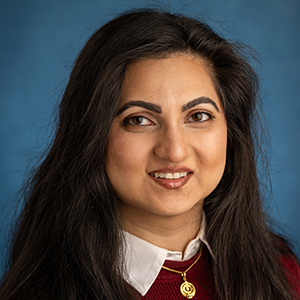
Bahaar Chawla, Ph.D.
Research Operations, Management, and Strategy Fellow
Michigan Medicine
Dr. Bahaar Chawla is a Research Operations, Management, and Strategy (ROMS) fellow in the Medical School’s Office of Research and holds a doctorate in Molecular, Cellular, and Developmental Biology from the University of Michigan (U-M). She recently completed a rotation with e-HAIL in which she explored member interest in science communication. But this isn’t her first foray into science communication.
As a doctoral student, Bahaar used the microscope worm, C. elegans, to understand how DNA must be compacted to fit into a cell, but still be accessible for gene expression. During her PhD, the COVID-19 pandemic led to shutdowns, and Bahaar was forced to leave her thesis work before finishing. While in lockdown, Bahaar became interested in science communication, especially as conversations about vaccine safety became common. She joined Skype-a-Scientist and later Letters to a Pre-scientist, two organizations which promote science communication with the public. Along with her volunteer work and her interest in how the institution oversees research policy, Bahaar found the ROMS fellowship as her next career move. The ROMS fellowship is a two-year program that prepares PhD-holding biomedical scientists for careers in research administration and more.
ROMS fellows start their time at U-M with a whirlwind of introductions to the different units in the Office of Research during their onboarding week. During this time, Chawla met e-HAIL Program Manager Henrike Florusbosch, who presented about the e-HAIL initiative. Since ROMS fellows are conveniently placed in the same North Campus Research Building as e-HAIL, Florusbosch would stop by and chat with them occasionally to see what projects they were working on and what their interests were. She and Chawla hit it off, particularly around the importance of science communication. When discussing the opportunity to do a rotation with e-HAIL, Chawla saw a rare opportunity in an academic environment: the chance to explore public facing communication and how to connect the research field with the public.
Rotations with programs in the Medical School’s Office of Research make up most of the program of ROMS fellows in their first year. Upon completion of the core rotations, Chawla was eager for an opportunity to do science communication with e-HAIL, given her growing interest in science communication since her time as a PhD student. “Most people only think about the creation of science policy, not the downstream parts—implementation and interpretation—and how to communicate those policies’ results from the research institutions back to policymakers,” Chawla stated.
During her e-HAIL rotation, Chawla conducted two main thrusts of research. In the first, she interviewed 22 e-HAIL faculty members, as well as staff from related departments such as communications, about their interest in science communication and what they are already doing in this regard. She was surprised to find some faculty who were heavily involved in science communication, even doing interviews with international news agencies in foreign languages. In contrast, a few faculty showed no interest in science communication. However, the majority fell between these two extremes—they had done some science communication, such as interviews with news outlets and being active on social media to promote their research, but were interested in learning about how they could up their game and what resources were available to support them.
Her second thrust was to create tools that faculty could use to conduct science communication, including a list of outlets, external resources to which they can refer, and a pipeline process tool. As part of this, she observed a pilot project that e-HAIL is supporting to draft a white paper, using what she learned from the process to create checklists and timelines for future projects. Drawing on her interest in art and design, she also created graphics and cartoons as part of a packet for faculty interested in science communication. Based on her interviews with faculty, she co-presented with e-HAIL Grant Writer Hossam Abouzahr on the importance of science communication, the unique challenges e-HAIL dyads face when trying to engage in it, and ways to overcome these challenges.
“We’re really seeing a growing interest in science communication among academics,” said Chawla, highlighting a 2018 report by the Union of Concerned Scientists that showed a changing relationship between government and the research community since President Trump’s first term. She hopes that interest continues to grow, particularly as academics become more aware of the importance of communicating with the public and government; but, she noted that the interest alone is not sufficient—there also have to be resources that faculty can utilize to help them get their message out. Fortunately, she found that many of these resources exist, it is simply a question of connecting the faculty with them. Based on what she learned, she’s considering doing a presentation with e-HAIL on exactly that—what resources are available at U-M and externally and how faculty can utilize them.
When asked about whether she’ll continue to explore science communication now that her rotation with e-HAIL is finished, she gave a definite yes. She’s currently considering doing an impact project with e-HAIL in the fall to apply what she has learned to help faculty produce some public-facing media such as articles in mainstream newspapers. In the long term, she is considering how to shift her career toward public and government engagement in science. She concluded: “There is value in having someone who understands science but is also willing to engage outside the traditional area of academic research.”
Editor’s note: If you are interested in science communication and want to learn more about Bahaar Chawla’s project, please contact ehail-info@umich.edu. You can also check out the Communications & Policy Engagement toolkit put together by the Institute for Healthcare Policy and Innovation (IHPI).